

Quick reply
Simple, advanced or qualified: what each eIDAS level covers, the legal weight it carries and the steps to adopt it in your company.



Going paperless in companies is one of the consequences of recent digital innovation. It does not stop at documents, though: signatures can be dematerialised too. That is what is commonly known as the electronic signature. Are you planning to use digital signatures in your company? Here is how they work, what makes them distinctive and what you can use them for.
What is an electronic signature?
Contrary to received wisdom, an electronic signature is in no way a scan of a handwritten signature. It is a technical process used to guarantee the authenticity, the integrity and the origin of a digital document, in the form of a string of numbers tied to a file and to the signatory. It rests on a set of computations through which the signatory gives legal approval to an electronic document. Like a handwritten signature, a digital signature involves three essential elements: the document, the signing tool and the signatory.
It allows the author of a digital file (JPG, .docx, XML and so on) to be authenticated credibly, and guarantees the integrity of the signed file.

How reliable is an electronic signature?
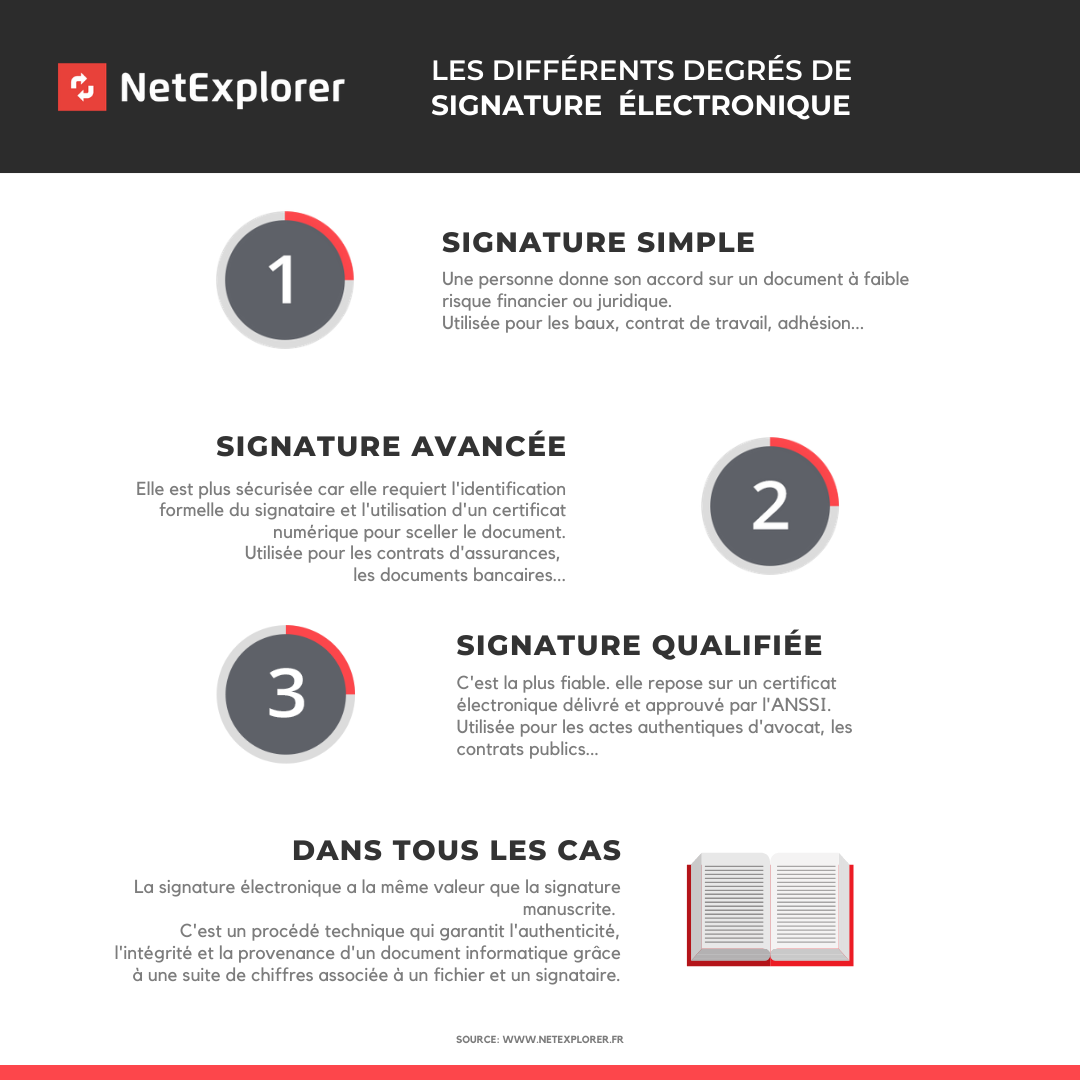
Under the European eIDAS regulation, there are three levels of reliability for digital signatures:
- the simple electronic signature,
- the advanced electronic signature,
- the qualified electronic signature.
With a simple digital signature, a person can give their agreement on a document carrying low financial and legal risk: tenancy agreements, employment contracts, membership forms and the like.
The advanced electronic signature offers more security. Producing one requires verifying the signatory's identity and using a digital certificate held on some form of medium. That might be an electronic identity card, a smart card or a USB key. Their function is to identify the signatory and seal the document. Advanced electronic signatures are used for instruments such as insurance contracts and banking documents.
The qualified electronic signature is the most reliable of the three. It rests on a digital certificate issued and approved by an official authority (in France, ANSSI, the national cybersecurity agency). This is the type of signature suited to notarised legal instruments and public contracts (awarding tenders electronically, for instance).
The advantages of the electronic signature
Digital signatures bring a number of advantages. They considerably shorten how long it takes to process documents in your company: there is no longer any need to have clients and partners travel to you, or to send paper letters out for signature. A single email gets you an agreement within a minute.
With digital signatures, printing your sensitive documents is no longer necessary. As a result, you manage them more easily and reduce what paper archiving costs you. Electronic signatures also save money (you spare yourself postal letters, with their envelopes, stamps, paper and ink). And you can sign your documents from anywhere: all you need is a phone, a tablet or a computer.
For getting a document signed by one person or by a group, the digital signature is very practical indeed.
How do you adopt electronic signatures?
To use electronic signatures in your company, you first have to choose one of the three levels. Next, you need to contact a provider specialising in electronic certification. The plan you subscribe to (offered as a package or a subscription) has to suit your needs. The following step is obtaining your digital identity certificate, which formally identifies the signatory. You therefore have to apply for your electronic certificate from a certification authority approved by the state. Finally, you have to install the electronic signature software. Bear in mind that the electronic certificate does not belong to the company: it does not represent your business, but rather the person running it.
What legal weight does a digital signature carry?
You need have no concerns about the legal validity of digital signatures. In France, they carry the same legal weight as a traditional signature. The law guarantees the reliability of any instrument to which an electronic signature is attached. A document signed electronically can therefore serve as evidence in a dispute before the courts. That applies directly only where an advanced or qualified signature has been used, though. With a simple signature, your company has to prove that the signing process was reliable.
When can you use an electronic signature?
Electronic signatures can be used in any situation involving a digital document. Contracts, amendments, payments, subscriptions and quotes can all be signed digitally. Their use is particularly valuable in a number of sectors, for the legal professions and for tenders. Training providers, banks and insurers are also concerned. In training, for instance, digital signatures make it easier to check attendance and sign agreements.
There are even situations in which you already use a digital signature without realising it. When you enter a code sent by text message to approve a payment, you are producing a digital signature: sending the code activates a unique digital certificate.
Digital signatures let you authenticate a digital document. But that document also has to be properly protected in a secure cloud environment. For managing your digital files, NetExplorer's expertise is there to support you. We offer capable, tailored ways of managing and sharing your digital data internally and with outside parties. Our entirely French platform is easy to get to grips with and fits neatly into your IT architecture, whatever the size and the particular circumstances of your company.
What is there to take away about the electronic signature? An asymmetric cryptographic process through which a person can authenticate a digital document, the electronic signature carries the same evidential weight as a handwritten one. It can even make a document valid as evidence before the courts. The advantages of using it in a company are numerous: it secures your exchanges, lets you formally approve your instruments and contracts, improves document management and makes you more effective. Do call on cloud experts to manage your digital documents securely, authenticated or not.
Other articles you might like
A high-performing DMS: quality document management for companies
Indexing, OCR, validation workflows and legal archiving: the features to expect from a DMS, and the key steps to roll one out.




But let's be honest, our cloud-based file storage and sharing solution is much easier.